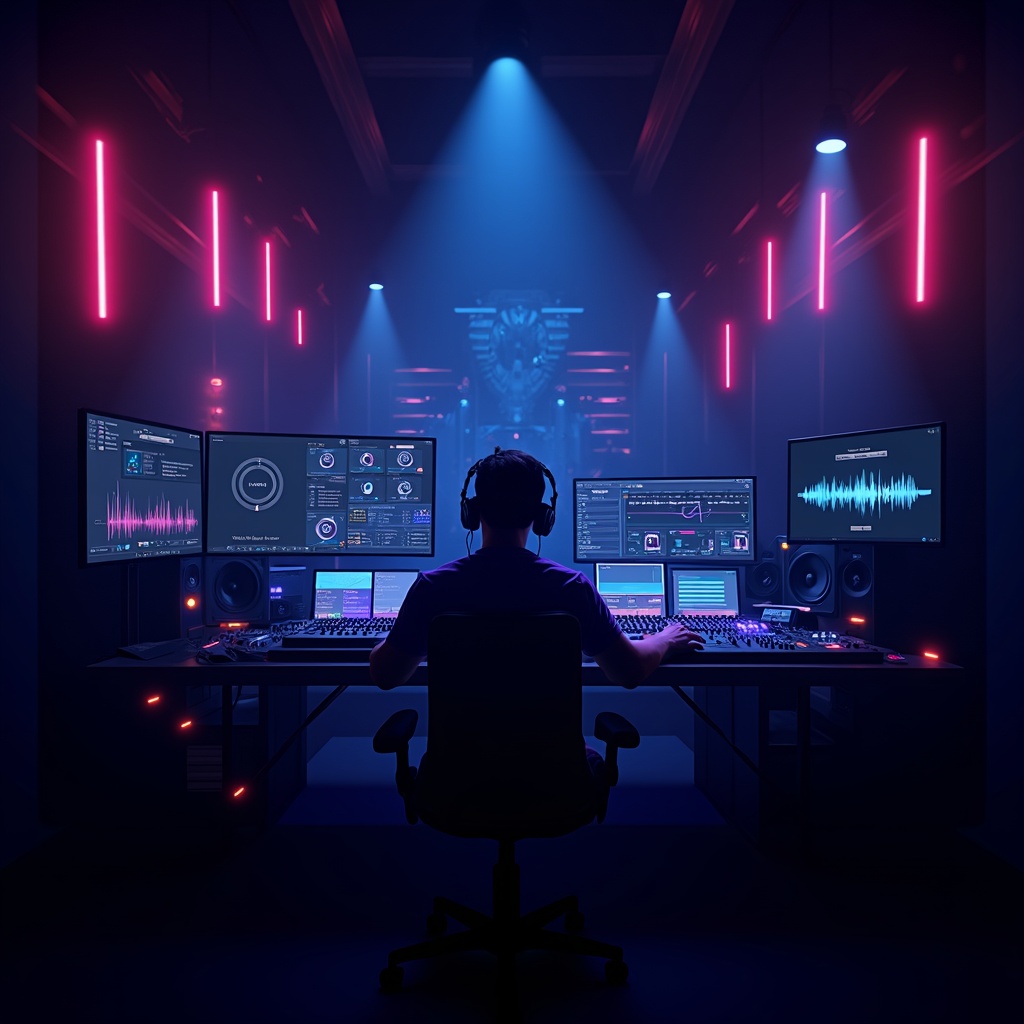
The music production world has entered a new era—one where artificial intelligence isn't just a novelty tool tucked into a corner of your DAW, but a fundamental creative partner reshaping how albums are conceived, constructed, and delivered to listeners worldwide. Whether you're a bedroom producer working on your first EP or a seasoned audio engineer managing complex sessions for major artists, understanding how AI music production tools work in 2026 is no longer optional. It's essential. This guide breaks down exactly what's changed, what works, and how independent musicians like you can leverage the most powerful AI music tools available right now to create professional-quality music faster and smarter than ever before.
The State of AI Music Production in 2026
Just five years ago, AI's role in music production was limited to novelty experiments—a chatbot that could generate a basic chord progression or a plugin that promised to "analyze your mix." The results were often underwhelming, and most professional producers dismissed the technology as a gimmick.
That dismissal is no longer tenable.
In 2026, AI music production tools are embedded into virtually every stage of the creative workflow. Machine learning algorithms now assist with composition, arrangement, mixing, mastering, vocal tuning, stem separation, sound design, and even music distribution metadata. Platforms like ShiMuv are at the forefront of making these capabilities accessible to independent musicians who previously couldn't afford an orchestra of engineers and session musicians.
The global AI music market has expanded dramatically, with billions of dollars flowing into research and development from both established tech giants and scrappy startups. The result? Tools that genuinely work, learn from your preferences, and—perhaps most importantly—get out of your creative way when you want them to.
Why 2026 Is a Turning Point
Several converging factors have made 2026 the definitive turning point for AI in music:
- Model maturity: Large language models and diffusion-based audio models have reached a level of sophistication where their outputs are consistently usable, not just occasionally impressive.
- Integration depth: AI tools are no longer standalone apps you have to export files into. They live inside your DAW, your mixing board interface, and your mobile production setup.
- Democratization of computing power: Cloud-based AI processing means you don't need a $10,000 workstation to run complex machine learning tasks in real time.
- Creator trust: After years of experimentation, independent musicians have developed informed opinions about which AI tools genuinely serve their creative vision and which ones undermine it.
How Machine Learning Is Transforming Music Composition
Composition has historically been the most fiercely protected domain of human creativity in music. The idea that a machine could write a melody that moves you emotionally seemed absurd as recently as 2020. Today, machine learning music models have fundamentally complicated that assumption.
Modern AI composition tools don't replace your musical instincts—they augment them. Think of them as a collaborator who has internalized millions of songs across every genre and can instantly offer you a harmonic alternative, a countermelody, or a rhythmic variation based on what you've already written.
Melodic Generation and Harmonic Assistance
Tools like Google's Magenta Studio and emerging competitors have trained models on vast datasets of MIDI files spanning classical, jazz, electronic, hip-hop, and everything in between. In 2026, these tools have become dramatically more context-aware. Feed them eight bars of your existing melody, and they won't just generate something technically compatible—they'll generate something that stylistically feels like it belongs in the same world as what you've created.
For independent musicians, the practical application is immediate:
Try this today: If you're stuck on a bridge section, use an AI melody generator to produce five variations. Don't use any of them verbatim. Instead, treat them as raw material—steal a rhythmic contour from one, a note choice from another, and arrive at something uniquely yours in a fraction of the time it would take to wrestle with writer's block alone.
AI-Powered Chord Progressions and Arrangement
Beyond melody, AI tools in 2026 offer sophisticated chord progression engines that go well beyond the simple "suggest the next chord" functionality of earlier iterations. Platforms like ShiMuv now incorporate arrangement intelligence that can analyze your track's current structure and suggest where a pre-chorus might strengthen the song, where you might need a dynamic drop to serve listener retention, and what instrumental textures could fill a sonic space that feels empty.
This is machine learning music at its most useful for songwriters—not replacing your creative decision-making but giving you an informed second opinion that's available at 2 AM when your bandmates aren't answering texts.
AI-Powered Mixing: The Death of the Guessing Game
Mixing has long been considered a dark art mastered only through years of trained listening and expensive studio time. The learning curve was steep, the cost of mistakes was high (burned through your entire reverb budget by the second track? Hope you like dry drums), and the gap between amateur and professional mixes was enormous.
AI mixing tools have compressed that gap significantly.
Intelligent EQ and Frequency Management
Modern AI EQ plugins—iZotope Neutron 5 being perhaps the most widely used example—use machine learning to analyze your audio in real time and make frequency-specific recommendations. But 2026's generation of tools goes further. They now understand genre context. An AI EQ working on a lo-fi hip-hop track applies different logic than the same AI working on a mastered orchestral piece.
The key innovation is spectral learning: these tools analyze your mix holistically, not just track by track. They identify frequency clashes between your kick drum and bass guitar before your ears catch them, suggesting specific cuts with the kind of precision that used to require a trained mixing engineer with a calibrated listening environment.
Automated Gain Staging and Dynamic Control
One of the most tedious aspects of mixing—proper gain staging across an entire session with twenty or thirty tracks—is now handled with remarkable accuracy by AI tools. Platforms integrated into popular DAWs like Ableton Live, Logic Pro, and FL Studio can analyze signal levels across your entire project and suggest or automatically apply gain adjustments that set you up for a clean mix before you've even touched a fader.
For independent musicians working without a professional engineer, this is transformative. Getting gain staging wrong cascades into every subsequent mix decision. Getting it right from the start means your compression sounds natural, your reverbs sit properly, and your final master has the headroom it needs.
AI Producer Perspective: Stem-Aware Mixing
One of the most exciting developments in AI music production is stem-aware mixing intelligence. Modern AI producers—AI systems designed to think holistically about a track the way a human producer would—can separate a mix into its constituent stems, analyze each element, and make mixing decisions that account for how sounds interact rather than treating each track in isolation.
This is the difference between an AI that makes your snare sound good in solo and an AI that makes your snare sound right in the context of the entire mix.
AI Mastering: Professional Results Without the Studio Rate
Mastering has traditionally been the final, critical step in music production—a process where highly specialized engineers with tuned listening rooms and expensive analog hardware put the finishing touches on a mix before it goes to the world. The cost ranged from $50 to $500+ per song, which put professional mastering out of reach for many independent artists.
AI mastering changed the economics of this completely.
How Modern AI Mastering Works
Services like LANDR, eMastered, and newer platforms have evolved their AI mastering algorithms to the point where the outputs are genuinely competitive with human mastering for a wide range of musical styles. In 2026, the technology underpinning these services uses deep neural networks trained on hundreds of thousands of professionally mastered tracks.
The process analyzes:
- Loudness (targeting appropriate LUFS for streaming platforms like Spotify, Apple Music, and Tidal)
- Dynamic range (ensuring your track breathes without losing competitive loudness)
- Spectral balance (making sure no frequency range is over- or under-represented)
- Stereo width (optimizing the stereo field for both headphone and speaker listening)
- Transient response (ensuring the punch and attack of rhythmic elements translate across playback systems)
When AI Mastering Shines (and When It Doesn't)
Here's honest, practical advice: AI mastering is excellent for electronic music, hip-hop, pop, and most genres with clear sonic references. It performs slightly less impressively on highly dynamic music—complex jazz, classical, or experimental genres where the nuance of the mastering decisions requires artistic judgment that current AI systems still struggle to fully replicate.
Actionable tip: For most independent artists releasing on streaming platforms, use AI mastering as your primary solution. If you're releasing something you genuinely believe has commercial or critical breakthrough potential, invest in one round of human mastering on top of AI pre-mastering. Many engineers now offer "AI-assisted mastering" services where they use AI as a starting point and apply their expertise to refine the result.
AI Stem Separation: A Revolution in Remixing and Restoration
If you want a single example that demonstrates how dramatically AI has changed music production, look no further than stem separation.
Stem separation—the ability to isolate individual elements (vocals, drums, bass, melody) from a fully mixed audio file—was once an imperfect process that produced artifacts and required significant post-processing to be usable. The technology was there in theory but not in practice.
Today's AI stem separation tools have achieved near-miraculous results.
Practical Applications for Independent Musicians
Remixing and covers: You can now take any song, separate its stems with high fidelity, and use the isolated elements as the foundation for a remix or reimagining. This opens creative doors that were previously locked behind sample clearance negotiations and studio relationships.
Sampling with precision: Producers who work in sample-based genres can now isolate the exact element they want from a record—a specific drum fill, a vocal ad-lib, a piano chord voicing—with the kind of clean isolation that used to require access to the original multitrack session.
Restoration and archival: Musicians recovering old recordings from demos or degraded media can use AI stem separation to isolate vocals from deteriorated backing tracks and re-record or replace the instrumental elements.
Tools like Moises.ai, Spleeter, and the AI-powered stem separation built into platforms like ShiMuv have made this capability accessible at a price point that independent musicians can work with—in some cases, completely free.
AI Vocal Tools: Pitch, Performance, and New Possibilities
Vocal production has seen some of the most dramatic AI innovations in recent years. The implications—creative, ethical, and commercial—are profound and still being worked out by the industry.
Intelligent Pitch Correction Beyond Auto-Tune
Traditional pitch correction tools like Auto-Tune and Melodyne have been staples of the industry for decades. AI has upgraded them significantly. Modern AI pitch correction doesn't just snap notes to a scale—it understands the stylistic intent of vocal performances and makes corrections that preserve the character of a performance while cleaning up genuine errors.
The difference is subtle but important: AI pitch correction in 2026 knows that the slight flatness in a blues singer's performance is intentional expressiveness, while the same flatness on a pop hook is a problem to fix.
AI Voice Cloning and Ethical Frameworks
Voice cloning technology—the ability to recreate a vocal style or even a specific voice using AI—is perhaps the most contentious development in AI music production. In 2026, this technology is powerful, accessible, and operating in a rapidly evolving legal and ethical framework.
For independent musicians, here's the practical reality:
- Your own voice: Using AI to clone and multiply your own vocal capabilities is increasingly common and legally straightforward. Tools that let you generate harmonies, backing vocals, or alternative emotional readings of your lead vocal from your own voice print are legitimate creative tools.
- Other artists' voices: This is where significant legal and ethical risk exists. Multiple jurisdictions have implemented or are implementing regulations around unauthorized voice cloning of public figures and artists. The creative opportunity is real; the legal exposure is also real.
Platforms like ShiMuv are building ethical frameworks into their AI tools—watermarking AI-generated content, requiring consent verification for voice cloning features, and staying ahead of regulatory requirements so that creators using their platform are protected.
AI Sound Design and Synthesis
Sound design—creating the textures, timbres, and sonic identities that define a genre or an artist's sound—is another domain where AI has made remarkable strides.
Neural Synthesis: Creating New Sounds From Nothing
Traditional synthesis (subtractive, additive, FM, wavetable) required significant technical knowledge to master. Neural synthesis—using AI models to generate entirely new audio from text prompts or example sounds—has lowered that barrier dramatically.
In 2026, you can describe a sound in plain language ("metallic percussion with a soft attack and a long reverberant tail that sounds like a rain stick made of steel") and receive multiple synthesized versions to audition. This isn't magic—it's diffusion-based audio generation, the same underlying technology that powers visual AI art generators—but applied to sound.
AI-Enhanced Sampling and Sample Library Creation
For producers who work with sample libraries, AI tools now allow you to:
- Extend samples: Take a two-second cello note and extend it to ten seconds with AI-generated natural decay and resonance.
- Transpose without artifacts: Pitch samples up or down far beyond what traditional time-stretching allows without introducing the artifacts that plague conventional methods.
- Transform sample character: Apply "style transfer" to samples, changing a dry studio piano recording to sound like it was captured in a large hall, or transforming a clean guitar into something that sounds like vintage tape.
AI Music Distribution and Metadata Intelligence
The production process doesn't end when you export your final master. Getting your music to audiences efficiently requires navigating an increasingly complex distribution landscape—and AI is making that navigation smarter.
Intelligent Metadata and Discoverability
Streaming platform algorithms serve music to listeners based partly on metadata: genre tags, mood descriptors, tempo, key, instrumentation, and dozens of other data points. Getting this metadata right is the difference between your track appearing in relevant playlists and getting lost in a sea of content.
AI tools in 2026 can analyze your finished track and automatically generate accurate, platform-optimized metadata. They can identify your track's BPM with perfect accuracy, detect the key, classify the genre and subgenre, and suggest mood tags that align with how streaming platform algorithms categorize similar music.
For independent artists without a label's A&R team to handle this work, AI metadata tools are a genuine competitive advantage.
Playlist Pitching and Audience Matching
Some AI music platforms are now offering intelligent distribution recommendations—analyzing an artist's sonic profile and suggesting which playlist curators, blogs, and Spotify editorial playlists their music is most likely to resonate with. This shifts music marketing from a scatter-shot approach to a data-informed strategy that maximizes your chances of meaningful discovery.
Building Your AI-Augmented Production Workflow
Understanding individual AI tools is valuable. Understanding how to integrate them into a coherent workflow is where independent musicians see real, lasting results.
The Recommended 2026 AI Production Stack
Here's a practical starting point for building your AI-augmented production setup:
Composition and arrangement:
- Use AI melody and chord generators in your DAW for brainstorming sessions. Dedicate one session per project specifically to generating AI material you'll use as creative raw material.
Recording and tracking:
- Use AI noise reduction (iZotope RX or similar) on all your recorded material before you begin mixing. Clean audio going into your mix makes everything downstream easier.
Mixing:
- Run your mix through an AI analysis tool (Neutron's Track Assistant or similar) at the beginning of your mixing session to identify problem frequencies and get an intelligent starting point for each channel.
Mastering:
- Use AI mastering for all demos, reference mixes, and releases where budget is a constraint. For flagship releases, consider hybrid human/AI mastering.
Vocals:
- Use AI pitch correction with "natural" settings that preserve performance character. Experiment with AI harmony generation based on your lead vocal for texture and depth.
Distribution:
- Use AI metadata tools to optimize your release package before submitting to distribution platforms.
Avoiding the AI Dependency Trap
Here's something no AI sales pitch will tell you: the most successful producers using AI tools in 2026 are those who maintain a clear creative vision that exists independent of their tools.
AI music tools are accelerants and amplifiers. If your creative instincts are strong, AI makes you more productive and expands what you can achieve alone. If your creative instincts are underdeveloped, AI will produce a lot of content that sounds like everything else, because it's trained on everything else.
Practical discipline: Give yourself regular "analog sessions" where you write, sketch, and create without AI assistance. These sessions keep your creative muscles strong and ensure that when you bring AI back into your workflow, you're directing it with genuine artistic intent rather than hoping it'll figure out what you're trying to say.
The Ethical Dimensions Every AI Producer Should Understand
As AI music production tools become more powerful, the ethical questions surrounding their use become more consequential.
Training Data and Artist Compensation
The AI models powering your favorite production tools were trained on music created by human artists—often without those artists' explicit consent or compensation. This is an active area of legal dispute across multiple jurisdictions, and the outcomes of these cases will shape how AI music tools are developed and deployed for years to come.
As an independent artist and user of AI music tools, you have a role to play:
- Support platforms with transparent training practices: Platforms that clearly disclose what data they've trained on and that have fair compensation frameworks for training data artists deserve your business.
- Be transparent about AI use: When you use AI tools significantly in creating your music, consider disclosing